 ← BetterEyez catalogue
On hold — seeking funding and development hardware
Vision Highlighter
An assistive-vision project designed for situations where poor vision causes foreground objects and background colors to blend together. A Windows proof of concept used the Sobel algorithm to highlight object edges, making people, vehicles, and environmental features substantially easier to distinguish.

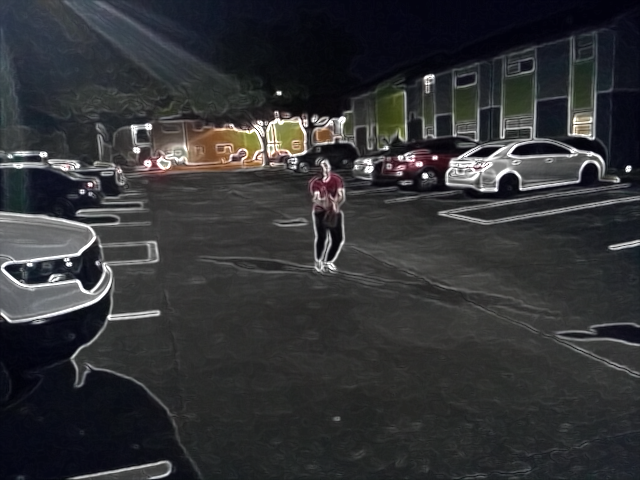
Make the foreground impossible to miss.
Created with Windows Forms, C#, Sobel Algorithm, and Computer Vision.
- Windows Forms
After several approaches to producing an Android build proved unsuccessful, I created a straightforward Windows interface instead. Full Sail lent me a Microsoft Surface so I could take the prototype into the field and perform real-world testing as part of my coursework.
- C#
Selected for its versatility, approachable development workflow, and the accessibility of the documentation and technical resources available for building the prototype.
- Sobel Algorithm
The Sobel algorithm detects sufficiently large changes in color intensity that indicate the edge of an object, then makes those boundaries visible as lines. This made it especially effective for highlighting foreground objects for people whose vision makes adjacent colors difficult to distinguish.
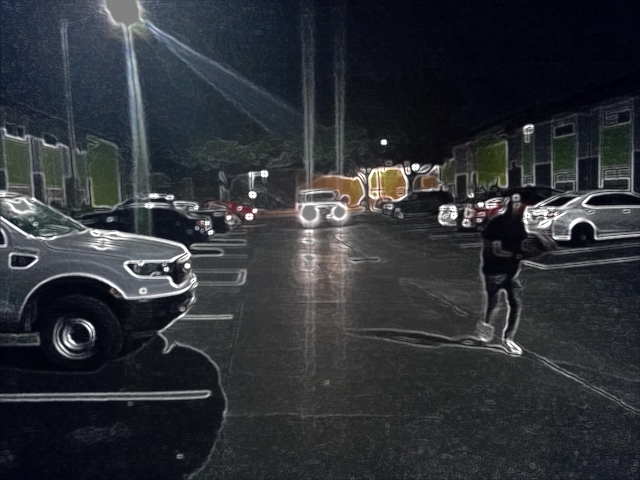
A field test using Sobel edge detection to distinguish foreground objects in a low-contrast nighttime scene - Computer Vision
Camera input and computer-vision processing turned the Sobel implementation into a usable real-time visualizer, and field tests produced extremely encouraging results. Continued development now depends on hardware that exposes suitable color-camera data to developers—access that many VR and AR headsets restrict because of privacy requirements and platform policies.
Vision Highlighter destination
A future demonstration, development page, or other project destination can be connected here when one becomes available.